
Groundwater plays a critical yet often overlooked role in sustaining life on Earth. As a vital component of the hydrological cycle, it serves as a hidden reservoir beneath our feet—supporting drinking water supplies, agricultural productivity, and ecosystem health worldwide.
While invisible to the naked eye, groundwater systems are complex, dynamic, and increasingly under pressure from overuse, pollution, and climate change. Gaining a deeper understanding of how these systems function is essential for ensuring their long-term sustainability and the well-being of the communities and environments that depend on them.
Key Takeaways
- Understanding Groundwater Systems: Groundwater resides in aquifers beneath the Earth’s surface and is replenished through natural and artificial recharge. It flows slowly and supports ecosystems, wells, and springs.
- The Importance of Groundwater: Groundwater provides drinking water to over 2 billion people and supports agriculture, industry, and ecosystems—especially during droughts when surface water is scarce.
- Challenges to Sustainable Groundwater Management: Over-extraction, contamination, climate change, and weak governance threaten groundwater resources. Many major aquifers are depleting faster than they are replenished.
- Principles of Sustainable Groundwater Management: Sustainability requires balancing recharge and extraction, protecting water quality, supporting ecosystems, and implementing inclusive, data-driven governance.
- Strategies and Best Practices: Solutions include managed aquifer recharge, efficient irrigation, wastewater reuse, and community-based management. Public awareness and policy support are essential.
- The Role of Technology and Innovation: Modern tools like remote sensing, AI forecasting, and digital groundwater models enhance monitoring, planning, and informed decision-making at multiple scales.
Understanding Groundwater Systems
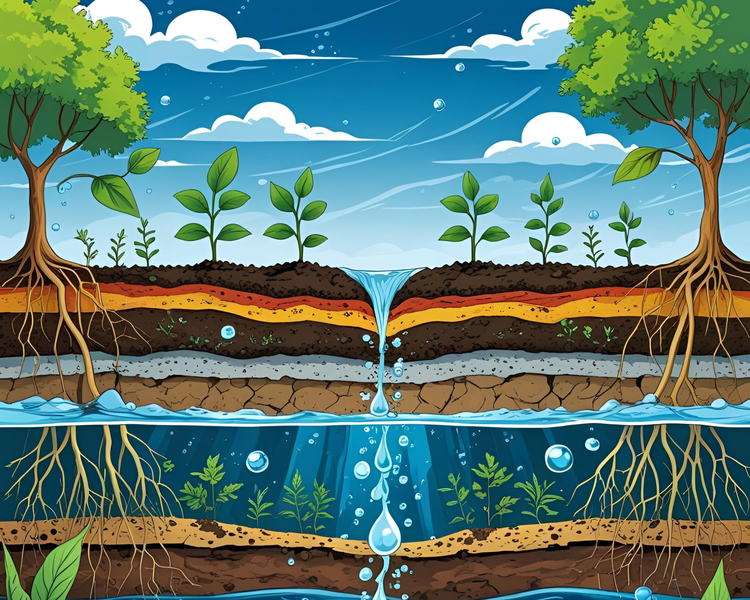
Groundwater is the water hidden beneath the Earth’s surface, residing in the saturated zones of soil and rock. As rainwater and melted snow seep into the ground, they eventually reach a depth where all pore spaces are filled—this is known as the water table. The geological formations that store and transmit this water are called aquifers.
Groundwater travels slowly through these porous materials, governed by principles such as Darcy’s law, and can remain underground for days to thousands of years, depending on local hydrogeological conditions.
Aquifers are classified into two primary forms: unconfined and confined. In unconfined aquifers, the water table marks the upper boundary, allowing recharge directly from surface rainfall and river seepage, which causes water levels to fluctuate naturally.
Confined aquifers, on the other hand, are sandwiched between layers of impermeable material—such as clay or dense rock—where the water is pressurised. When tapped by wells, this pressure can cause water to rise above the aquifer, as seen in artesian situations.
Groundwater is replenished through two key processes: natural and artificial recharge. Natural recharge occurs when precipitation infiltrates the vadose zone and percolates downward into the aquifer. Additionally, water from rivers, lakes, or wetlands seeps into the subsurface and helps maintain the system. Discharge happens when groundwater reemerges—via springs, baseflow in streams, or through artificial wells. Effective management requires balancing these recharge and discharge processes to sustain aquifer health.
The Importance of Groundwater
Groundwater is a foundational resource for humanity. It provides nearly half of the world’s drinking water and supports critical industrial and agricultural activities. Its role as “nature’s insurance” becomes evident during droughts, when surface water becomes scarce and communities turn to subsurface reserves for water.
In agriculture, groundwater is indispensable. Approximately 70 % of global groundwater withdrawals support food production—irrigating fields, sustaining livestock, and processing crops.
Approximately 38% of irrigated land relies on groundwater, with a greater dependency in regions such as India, North America, and South Asia. Industrial sectors, ranging from manufacturing to mining and bottled water, account for approximately 19% of global groundwater use, with usage rates varying significantly by region.
Globally, over 2 billion people use groundwater as their primary source of drinking water. In Europe alone, groundwater supplies approximately 65% of public drinking water and 25% of agricultural irrigation needs. Beyond physical sustenance, groundwater underpins economic development, supporting farms, industries, and jobs, especially in regions where surface water is scarce.
Challenges to Sustainable Groundwater Management
Across the globe, scientific analyses reveal that approximately 71 % of the planet’s 1,700 major aquifers are experiencing declining water levels, with around one-third undergoing accelerated depletion in recent decades.
In areas like the Colorado River basin, massive extraction since 2003—equivalent to draining Lake Mead—has caused water tables to plunge, making wells deeper, more costly, and, in some cases, practically unreachable.
Contamination also threatens groundwater safety and usability. Excessive fertiliser and pesticide use in agriculture contributes nitrates and chemical residues to the subsurface, while industrial and urban effluents introduce other toxins. In the European Union, around one-quarter of its groundwater is deemed chemically poor due to such pollutants.
Climate is shifting precipitation patterns, and more frequent droughts diminish natural recharge, while increased demand for groundwater during dry spells exacerbates stress. Coastal aquifers face the additional threat of saltwater intrusion, driven by rising sea levels and the degradation of freshwater barriers.
Governance and data deficiencies compound these physical threats. Many aquifers suffer from insufficient monitoring, weak regulation, and a lack of transparent extraction records. In such environments, unregulated use can lead to uneven depletion, inequity, and long-lasting damage—land subsidence and compromised aquifer storage being prime examples.
Principles of Sustainable Groundwater Management
A central tenet of sustainable groundwater management is maintaining a balance between extraction and recharge.
When human withdrawals exceed the rate at which water naturally restores through rainfall and seepage, aquifers decline—often with serious consequences like subsidence and deeper drilling. Globally, aquifers beneath densely irrigated regions are facing alarming depletion, especially where recharge is insufficient due to prolonged droughts or limited rainfall.
Protecting groundwater quality is equally essential: even modest contamination from pesticides, industrial agents, or nitrates can render water unfit for human or ecological use.
Sustaining ecosystems that rely on groundwater is another critical principle. Many rivers, wetlands, and forests depend on subsurface flow; if groundwater is over-exploited, these systems suffer, leading to losses in biodiversity and ecological resilience. Modern planning, therefore, includes “environmental flow” requirements that allocate water for industry, agriculture, and nature itself.
Ultimately, sustainable management requires long-term planning grounded in robust data, clear regulations, and inclusive governance. Effective regimes require monitoring, stakeholder representation, and adaptive policies that can respond to changing conditions. Engaging farmers, industry, municipalities, and local communities ensures transparency, equity, and shared responsibility for aquifer stewardship.
Strategies and Best Practices
Academic and field-based science offers a suite of strategies to operationalise these principles:
Managed Aquifer Recharge (MAR)
In arid or over-exploited regions, intentionally recharging aquifers can replenish depleted groundwater.
Techniques range from spreading waters in basins to engineering infiltration galleries. However, these systems must be matched with local geology and water quality monitoring to guard against clogging or contamination.
Policymaking frameworks in places like Arizona, California, Italy, and Mexico now support MAR via permitting systems and legal stipulations that ensure both quantity and quality safeguards are in place.
Water-Efficient Irrigation
Agriculture accounts for around 70% of global groundwater usage, so smarter irrigation saves immense volumes of water. Techniques like drip or sprinkler systems deliver moisture directly to plant roots, significantly reducing waste — a step towards synchronising extraction with recharge.
Use of Recycled and Treated Wastewater
In water-stressed regions, the reuse of treated effluent via MAR or direct reuse has grown. For instance, California’s Flood-MAR initiative blends excess surface water with treated runoff to recharge cropland while taking care to reduce nitrate loading through clean water sources.
Community-Based Management
Empowering local communities to manage aquifers has shown strong results. In India, villagers trained as “Bhujal Jaankars” monitor local water tables, engage in recharge initiatives, and serve as stewards of their aquifer—exemplifying how science and community action blend to foster sustainable use.
Public acceptance and behaviour change are pillars of sustainable groundwater systems. Awareness campaigns that transparently explain MAR technologies, their benefits, and safeguards help build trust, especially when treated water is part of the equation. Alongside institutional frameworks, efforts to inform farmers, consumers, and municipal users cultivate a conservation-minded culture.
The Role of Technology and Innovation
Geographic Information Systems, remote sensing, and data analytics have transformed groundwater management. In California, remotely sensed data— aerial electromagnetics from helicopters—help identify where aquifers can most efficiently recharge, enabling targeted interventions that save time and money. Meanwhile, big data initiatives in McGill-led research have shown that historical groundwater sampling needs updating: analysing over 200,000 samples nationwide revealed that outdated definitions of fresh groundwater limits may hinder sustainable decision-making.
“Smart” metering and digital groundwater models are becoming indispensable tools. California’s Sustainable Groundwater Management Act encourages agencies to adopt tools like C2VSim, a publicly available numerical simulation model, to forecast aquifer response under different extraction and recharge scenarios. Digital models are now often combined with accessible spreadsheet tools, fostering transparency, reproducibility, and stakeholder trust.
Emerging mobile and AI technologies enhance these capabilities further. In India, advanced algorithms—such as optimised Long Short-Term Memory neural networks—have been used to forecast groundwater levels from well measurements and rainfall data, yielding better predictive accuracy than simpler models. In California, fibre-optic seismic sensing—using passing vehicles as vibration sources—has enabled daily, high-resolution monitoring of groundwater table changes after storm events, revealing how recharge responds across different land covers.
Conclusion
Groundwater is a vital yet finite resource that sustains billions of people, fuels global agriculture, and supports critical ecosystems.
As pressures from climate change, population growth, and unsustainable practices intensify, the need for responsible groundwater management has never been more urgent.
By understanding the science of aquifers, embracing innovative technologies, and fostering inclusive governance, we can shift toward practices that safeguard groundwater for current and future generations. Achieving sustainability requires coordinated action—from local communities to global policymakers—to ensure that this hidden lifeline continues to serve both people and the planet.